AI voice agents

AI voice agents for local service businesses.

Answer routine calls, share approved business information, gather useful details, route or transfer callers, and send the right context to your team without asking AI to make every decision.

  • Approved knowledge
  • Human handoff
  • Structured follow-up

The goal is not to automate every conversation.

The useful question is not whether AI can talk. It is which parts of the call are repetitive enough to automate and which parts still need a person.

Routine work · Approved rules

Good work for the agent

  • Answer approved questions
  • Explain services, hours, and service areas
  • Gather caller details and the reason for calling
  • Collect job or request context
  • Route the caller
  • Submit an approved booking or quote request
  • Send structured context for follow-up

Judgment · Exceptions · Sensitive calls

Keep a person in control

  • Unusual pricing or discounts
  • Complex service-fit judgment
  • Complaints and refunds
  • Safety or emergency advice
  • Sensitive customer situations
  • Legal, medical, or regulated advice
  • Promises the system cannot verify
  • Exceptions outside approved business rules

The agent should be useful because its limits are clear, not because it pretends to know everything.

A useful call has a simple loop.

WCAP's bounded call loop gives each conversation a purpose, a limit, and a useful next step.

  1. 1

    Answer

    Start with the approved business identity and understand why the person called.

  2. 2

    Gather

    Ask only for the information needed for this call type.

  3. 3

    Help

    Answer from approved knowledge or use a specific allowed tool.

  4. 4

    Handoff

    Transfer, route, or create a clear follow-up when human judgment is needed.

  5. 5

    Record

    Leave the team with useful context instead of making them restart the conversation.

What an AI voice agent can actually do.

Capabilities depend on the business, phone setup, approved information, integrations, and risk of each action. We only connect the pieces the workflow needs.

Answer from approved business knowledge

The agent should answer from maintained business information rather than inventing policy or service details.

  • Services, hours, and service areas
  • Approved pricing or quote rules
  • Policies and preparation instructions
  • Common questions

Gather structured intake

Collect what the team actually needs, not a giant interrogation on every call.

  • Name and callback number
  • Service needed and location
  • Vehicle or property details
  • Urgency, issue, and preferred next step

Use bounded tools

Tools are permissions. Each one should have a clear purpose, inputs, error path, and fallback.

  • Look up approved information
  • Check a supported business system
  • Submit a booking request or create a lead
  • Trigger an approved internal workflow

Transfer or route

When a person is the right next step, the agent should hand off instead of stretching the conversation.

  • Sales or an existing customer
  • Owner or service department
  • Urgent or high-priority request
  • Sensitive issue

Send useful post-call context

The team should know what happened without replaying the whole conversation.

  • Summary and caller details
  • Reason for the call and outcome
  • Requested follow-up and priority
  • Structured fields where configured
What makes this a voice agent?

An AI voice agent is a phone-based conversational system built around approved business knowledge, specific call-handling rules, and a limited set of actions. It can answer routine questions, gather information, route callers, use approved tools, and hand the call to a person when the conversation moves beyond its scope.

An AI receptionist is one common use. A voice agent can also be scoped to a narrower intake, routing, or request workflow.

If it does not know, it should not guess.

The next step should become more bounded as the conversation moves beyond approved information.

A good fallback is part of the product. It is not an admission that the AI failed.

  1. 1

    Answer

    Approved information is available.

  2. 2

    Clarify

    Ask one or two useful questions when the request is ambiguous.

  3. 3

    Take a message or request

    Capture the details needed for human follow-up.

  4. 4

    Transfer

    Hand the caller to an approved person or destination when needed.

  5. 5

    Stop

    Do not invent an answer, appointment, price, diagnosis, promise, or business rule.

Choose when the agent should answer.

Every business does not need the AI on every call.

1

First line

Caller → Agent → Person when needed

The voice agent answers inbound calls first and transfers when the caller needs a person.

Best when: Routine questions and intake make up a large share of calls.

2

Overflow

Caller → Team busy → Agent

The normal team answers first. The agent handles calls when staff are busy or another line is occupied.

Best when: The business wants human-first coverage with a fallback.

3

After hours

Caller → Agent → Team follow-up

The agent handles supported calls outside normal staffed hours and creates the right next step.

Best when: Callers need information or intake when the team is unavailable.

4

Specific call types

Selected calls → Agent → Approved next step

Only certain numbers, campaigns, departments, or call reasons go to the agent.

Best when: The business wants a narrow, controlled first deployment.

Start with the smallest call scope that creates real value. Expand only after the workflow is proven.

Keep the phone setup that already works where practical.

We review the current provider, number, routing, and transfer options before recommending a change.

Existing business number

Depending on the current provider and routing, the existing number may be connected, forwarded, or routed into the agent workflow rather than replaced.

Dedicated AI line

A separate number can make sense for after-hours, a campaign, a department, or controlled testing.

Existing telephony infrastructure

Supported phone systems can sometimes connect through provider integrations or SIP rather than forcing the business to rebuild the whole phone setup.

Human transfer destinations

Approved people or departments can receive transfers where the phone integration supports them. Transfer behavior and the unavailable-person fallback need to be tested.

Compatibility, number handling, and transfer behavior depend on the actual phone integration. Keeping a number unchanged or using a warm transfer is not assumed.

What happens after the caller hangs up matters too.

The conversation should leave useful context for the person who owns the next step.

  1. 1Conversation ends

  2. 2Approved analysis runs

  3. 3Useful details are extracted

  4. 4Team or business system receives context

  5. 5Human follows up where needed

Depending on scope, this can include a summary, caller details, outcome, urgency, classification, an internal notification, a lead or CRM record, and requested follow-up. Extracted details still need appropriate checks.

Recording, transcription, disclosure, consent, retention, and access are reviewed as part of the implementation where those features are used. Audio storage is not assumed, and transcripts are not perfectly accurate.

The wider follow-up workflow belongs to Lead Follow-Up Automation.

We use voice agents inside a service business we operate.

WCAP Detailing is our owned Halifax mobile detailing business. Its voice agent works from approved service information and operating rules, gathers the details needed for the request, and connects into the same booking logic the business actually uses.

  • Approved service information
  • Quote logic
  • Add-ons
  • Availability
  • Intake
  • Vehicle validation

For booking, the agent submits a request for manual confirmation. It does not invent availability or create a confirmed appointment on its own.

See WCAP Detailing
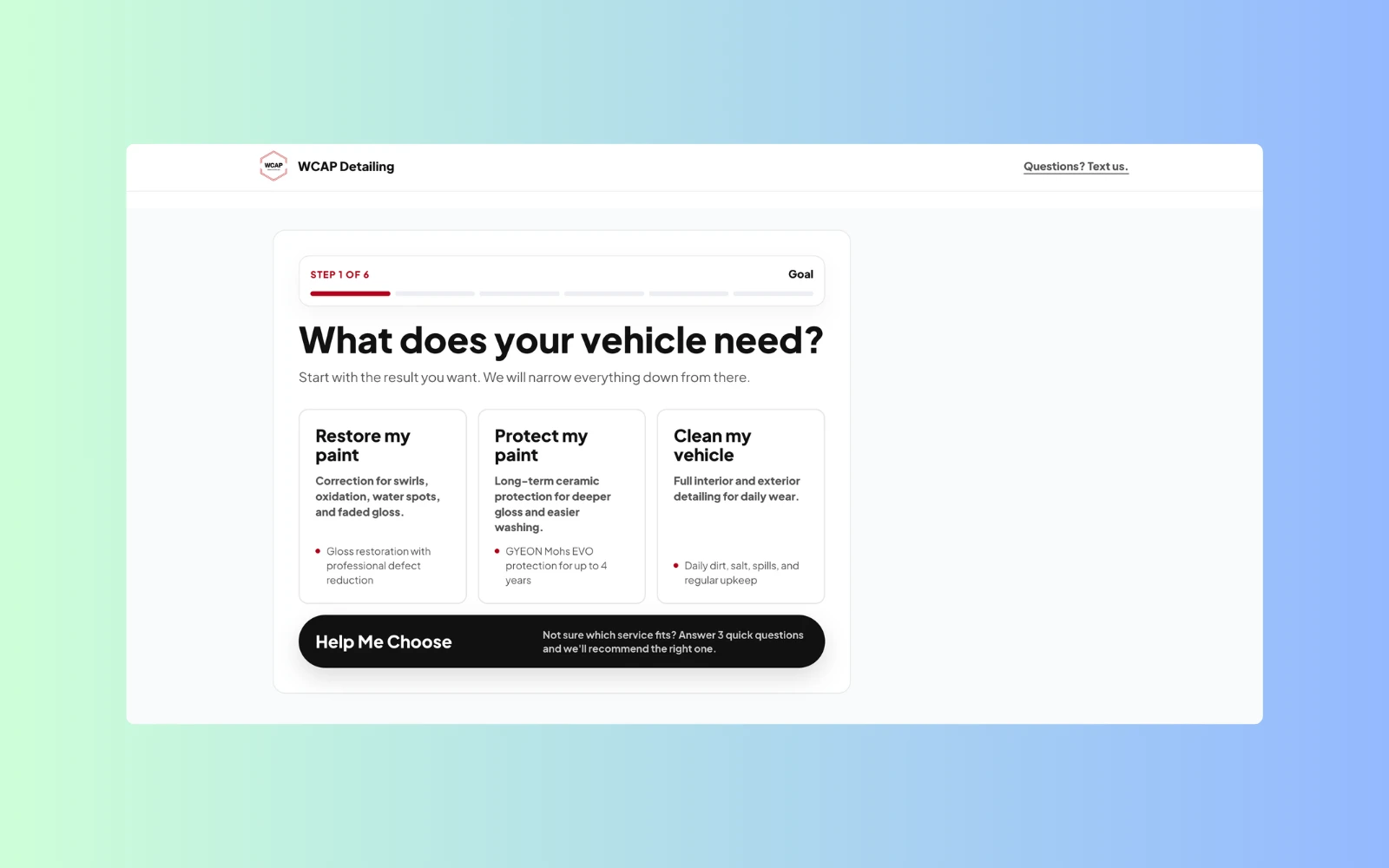
WCAP Detailing booking flow goal step with paint correction, protection, and cleaning service choices.
Booking starts with clear service selection instead of a generic contact form.

This is the real customer booking flow, not the voice-agent interface. The voice workflow connects to the same service and booking logic.

Human handoff should be designed before launch.

The handoff contract makes ownership clear before the first caller reaches a human boundary.

When?

What conditions mean the agent should stop handling the call itself?

Who?

Which person, department, or fallback owns that call?

What context?

What should the human know before taking over?

What if nobody answers?

Does the caller leave a structured message, receive a safe next step, or follow another approved path?

Transfer is not enough. The business needs to know what happens when transfer succeeds and when it does not.

We test the calls that are supposed to go wrong.

A happy-path demo is not enough for a production phone system. Test before trust.

  • Approved questions

    Can the agent answer normal business questions correctly?

  • Unknown questions

    Does it refuse to invent information?

  • Interruptions

    Can a caller interrupt or change direction without breaking the flow?

  • Tool failure

    What happens when an external system is unavailable?

  • Transfer

    Does the right call reach the right person with the right context?

  • No human available

    Does the fallback behave safely?

  • Bad or incomplete information

    Does validation catch unusable phone numbers, missing details, or conflicting input?

  • Sensitive or out-of-scope call

    Does the agent escalate instead of improvising?

From call map to a narrow launch
  1. Map the calls

    Identify the call types, information callers need, what the business needs to collect, and what should always go to a person.

  2. Build the source of truth

    Organize the approved services, hours, service areas, policies, pricing rules, FAQs, and escalation rules the agent may use.

  3. Connect the narrow tools

    Add only the phone routing, transfers, booking/request actions, notifications, or integrations needed for the approved workflow.

  4. Test edge cases

    Test normal calls, unknown questions, interruptions, tool failures, transfers, unavailable staff, and sensitive requests.

  5. Launch narrow

    Start with the smallest useful coverage mode rather than putting the agent on every possible call immediately.

  6. Review real calls

    Use call outcomes and staff feedback to improve the workflow without quietly expanding the agent's authority.

Scoped quote

Voice agents are scoped around the calls they need to handle.

A simple after-hours intake agent and an agent connected to live business systems are different projects. WCAP scopes the smallest useful deployment first.

Third-party telephony, voice-platform usage, integrations, and ongoing support are defined in the agreed scope before launch.

What changes the scope

  • Call volume and coverage mode
  • Phone setup and transfer rules
  • Business knowledge and call types
  • Tools, integrations, and booking or quote workflow
  • Data captured and post-call handling
  • Testing complexity, maintenance, and monitoring
  • Provider usage and separately approved outbound use

Outbound AI calling is separately scoped and requires additional compliance review. It is not assumed as part of the standard inbound voice-agent service.

Sensitive or regulated workflows need stricter scope, data, disclosure, escalation, and compliance review.

A voice agent is not always the first fix.

WCAP should recommend the smallest useful system, not AI because AI is available.

The call volume is tiny

A simple human process, voicemail, or call forwarding may be enough.

Nobody agrees on the business rules

If the team gives different answers about services, prices, availability, or escalation, fix the source of truth before putting AI on the phone.

Nearly every call requires expert judgment

If routine intake is rare and each call is sensitive or case-specific, forcing automation may create more risk than value.

There is no human fallback

An agent should not be the end of the road when a caller needs a person.

The real problem happens after the call

If enquiries are captured correctly but staff follow-up is slow, Lead Follow-Up Automation may be the better first project.

Questions about AI voice agents

Let us map how your calls should work.

Tell us which calls interrupt the work, what callers need, and where a person should take over. We will map the smallest useful voice workflow first.

Free preview. No obligation. No required monthly plan.

Prefer to talk first? Call +1 (902) 706-8171 or send a text.